Ohio State Alumni Magazine – Alumni Interview
I had an article published in Ohio State Alumni Magazine’s September – October 2009 edition. Check it out here:
- Ohio State Alumni Spotlight: Judy Gamble Kahrl
- Here is the PDF scan of the magazine.
I had an article published in Ohio State Alumni Magazine’s September – October 2009 edition. Check it out here:
I just finished reading Equus, the 1975 Tony-award winning play written by Peter Shaffer and recently revived on Broadway with stars Daniel Radcliffe and Richard Griffiths.
The play revolves around Alan Strang, a troubled boy of 17 who has been court-ordered to receive care after he blinds six horses with a metal spike. His foil is Dr. Martin Dysart, a psychiatrist who is Strang’s last resort.
It’s in the therapeutic setting that the two go to battle (and is a far cry from the tête-à-tête between Matt Damon and Robin Williams in Good Will Hunting). It is revealed that Strang, torn between an atheistic father and a Christian mother, creates his own religious world evolving the sexual and spiritual worship of horses.
The play’s action is focused on Dysart coaxing Strang to reveal his thoughts and motivations. Dysart is able to do so, in part, because he, himself is in crisis. Strang’s inner world is an obsession of which Dysart, a man tired of his profession and marriage, is jealous.
“But that boy has known a passion more ferocious than I have ever felt in any second of my life. And let me tell you something: I envy it.” (Act II: Scene 25)
Dysart has a professional responsibility to save Strang and society from the consequences of the boy’s obsession. But in doing so, Dysart realizes he must end the boy’s passion—his most raw and truthful part of himself.
I was amazed with the depth of the play, which I only read and never seen performed. The precision of the dialogue reminded me of the meticulousness of poetry. Equus is a remarkable and haunting work.
***************
To my chagrin, I hadn’t heard of the play until Radcliffe joined the London production. But here is Dan Radcliffe’s interview on Inside the Actors Studio that really motivated me to seek out the text.
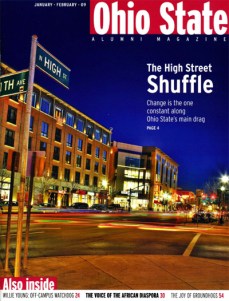
Ohio State Alumni Magazine
I just received my contributor’s copies from Ohio State Alumni Magazine for a story I wrote about Willie Young, Ohio State’s Off-Campus Student Services Director.
I first met Young when I was working on my master’s of Journalism and Communication at OSU, and he let me ride along with him during a weekend night. He was very gracious with his time with this former grad student and really does care about the students. I’m happy he was able to be featured.
The fun part for me is I pitched this story almost five years ago, and it was good Mr. Young remembered me. Lesson learned: You just never know when queries might get answered.
Now that Christmas has passed without incident, I’m looking forward to the New Year and the possibility of fresh starts. I plan to write more in 2009, because, frankly, I just need to for my own sanity. My volunteer responsibilities are decreasing, so I should have more energy to devote to the vicious cycle of writing, editing, crying, re-editing. I might even try my hand at fiction again.
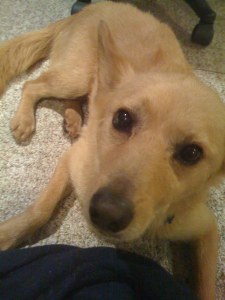
Penny
But, on a personal note, I need to mark 2008 as the year of the dog. After much debate, Marc and I adopted a 4-year-old cattle dog mix named Penny in August from the SPCA Cincinnati. She has been surprisingly fun, probably just to me as a recovering cat owner. She has held me accountable to my exercise routine and makes lying on the floor look like the most comfortable place to be. I can’t wait to get to know her better in the upcoming year.
Happy New Year, everyone!
I have been having great fun with my iPhone apps since their official launch in the summer. My favorite app has become the free and updated Google app with voice searching. Two surprising uses: to spell words that I hear on my audiobooks and to write lines of poetry as I drive (or at least noting the key words).
The other day, I wasn’t sure how to spell “espadrilles” but Google did. (It was important because I’m now listening to Confessions of a Shopaholic on tape). And I was able to start a new poem on my way home by capturing the key words of lines I wanted to remember. It was great.
I have ridden the snake-like road of I-64/77 through southern West Virginia at least twice a year since I was a girl and grew up in awe of the ancient Appalachian Mountains. But a few years ago, I noticed my first mountaintop removal site just off the highway between the valley of two other mountains. Its bleak look, desert tan in high elevation, was shocking in contrast to its green counterparts.
Michael Shnayerson recounts a similar situation in his book, Coal River: How a few brave Americans took on a powerful company—and the federal government—to save the land they love (2008). Shnayerson’s principal character, Joe Lovett, noticed similar sights as he drove along the same road also known as the West Virginia Turnpike. Lovett is a West Virginia environmental lawyer who has been working on stopping mountaintop removal mining years before I noticed anything.
The book concentrates on Lovett’s representation of local activists and their lawsuits to stop mountaintop removal. The suits were mainly brought against the Army Corps of Engineers, the coal company, Massey Energy, and its CEO and political big-spender Don Blankenship.
Coal River’s literary tradition comes from other legal nonfiction such as Jonathon Harr’s book, A Civil Action (1995), and the 2000 movie, Erin Brockovich. (But this book does lack the fun use of feminine wiles). Water polluting is a major factor in all of these stories, including Coal River.
Lovett’s main legal argument is that, beside the loss of America’s “mother forest,” mountaintop removal permanently obliterates waterways with debris and dangerous contaminants, making the process a dire short-term solution with irreversible consequences.
While Lovett makes a sturdy case against mountaintop removal mining, Shanyerson is heavy-handed in his retelling, never attempting to provide a decent case for the other side. His heroes are portrayed as faultless angels; his villains as close cousins to Skeletor.
But once I was able to accept the author’s bias, I found Coal River a satisfying read even with the need to supplement the knowledge. It is a relevant book about what is happening now in terms of energy production, corporate responsibility, mine safety, environmental law, and state and federal politics–a complex policy issue not just for West Virginia but for the nation.
To provide more information mountaintop removal mining, here are some additional links:
Nonpartisan voting information for Ohio is available at SmartVoter.org, a Web site managed by the League of Women Voters. Here you can get candidate and issue information. You can also get a sample ballot. Remember you’ll see eight presidential tickets on the Ohio ballot. Here is a list of all presidential tickets, including write-ins.
Other links for voters in Ohio:
Hamilton County is fully participating on SmartVoter with candidate and issue information for county offices and city and village issues.
Highlights on SmartVoter for Hamilton County:
Find more information about voting and elections in Southwest Ohio at the League of Women Voters of the Cincinnati Area.
Ohio, you’re so fun, especially during election time. I know I’m in the minority, but I have been enjoying the flurry of mostly local campaign ads and direct mailers in this final gasp of the election season.
I can contribute this euphoria to three personal and selfish items:
So for me, its all over but the shoutin’ and the countin’. In celebration, I’ve created an Ohio playlist to inspire during this final week of election mania (Listed by song, artist and website to listen).
Any other suggestions?
Poverty is the focus of Blog Action Day this year. And since I serve on the board of Over-the-Rhine Community Housing, I wanted to let you know more about this nonprofit community development corporation in Cincinnati.
OTRCH’s mission is to stop homelessness by providing affordable housing. According to the Greater Cincinnati Coalition for the Homeless, the loss of income and lack of affordable housing are the top reasons for homelessness in our area, and, in the past 15 years, homelessness in Cincinnati has increased by 150 percent.
OTRCH uses countless hours of volunteer time to turn buildings into affordable housing. This ‘sweat equity’ helps keeps costs low and rents affordable. Groups (schools, churches or businesses) and individuals are welcome to volunteer. OTRCH also has a wonderful internship program–which I can recommend being a former intern myself.
If you want to know more or get involved, OTRCH is hosting its annual fund raising event this week on Thursday, October, 16 at Music Hall (PDF of invitation). Historian and newscaster Dan Hurley is scheduled to speak about It’s About People: The History and Future of Over-the-Rhine.”
I hope to see you there.
After next month, the poetry group I’ve been a part of for the past three years will be disbanding. I am sad about it. It has been great to have the support of other writers and the monthly deadline. Because of this group, I actually have a stockpile of coherent poetry. Thanks Kristi, Joan and Cam for your insights and dedication to the well-written word.
Here is a partial list of our prompts we used for our meetings. I know I’m missing a bunch, but I take it as a good sign I can’t remember the prompt when reading through the poems.
Partial list of poetry group assignments:
 Melissa Currence